Sciences - Astronomy
Observing the Universe - Practise - Observing
The Universe
Practise - Observing
Our Galaxy - The Milky Way
Galaxies
Quasars - Expansion of the Universe


1) Equipment for observing the Universe


1.1) Introduction


For the budget of a 2 or 3 weeks trip to another continent, it is possible to equip yourself to acquire images of objects in the sky. I started by implementing the most precious equipment which is a camera which must be as sensitive as possible to light on a refracting telescope and a small motorized mount.


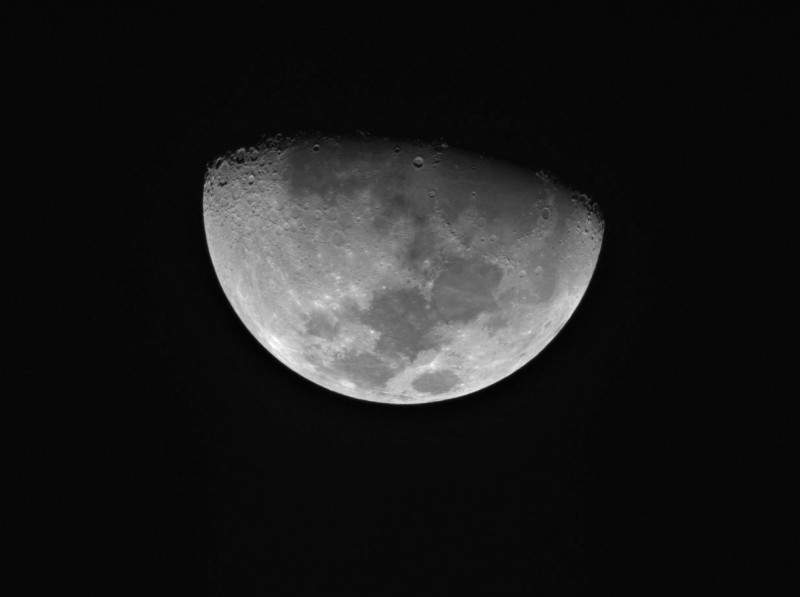
Presentation of the acquisition camera being tested on the most obvious target (The Moon) behind my first 80 mm diameter refracting telescope on a small one-axis motorized mount, a mini EQ that can support up to 3 Kg payload


The camera Atik Infinity is connected to the computer by a USB cable for its control and image transfers.
Another cable is dedicated to its 12V power supply
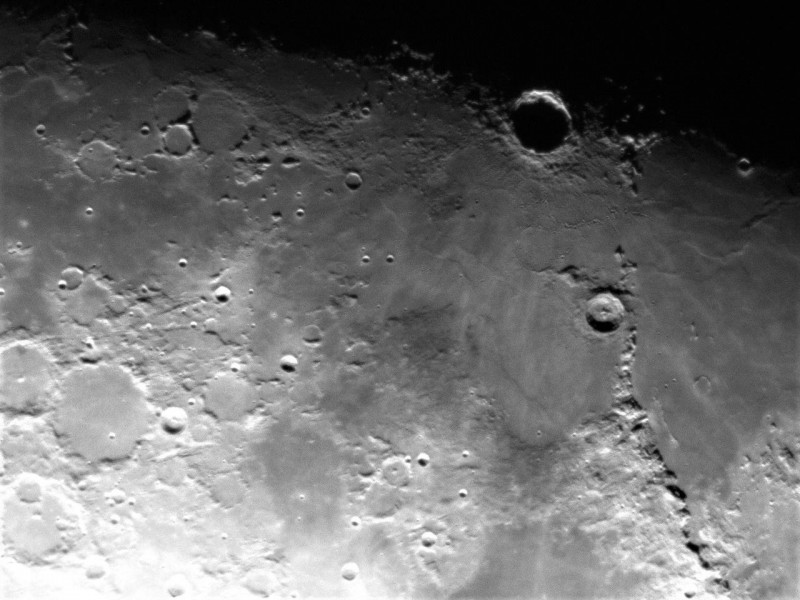
The software allows you to visualize in real time what the "electronic eye" sees...


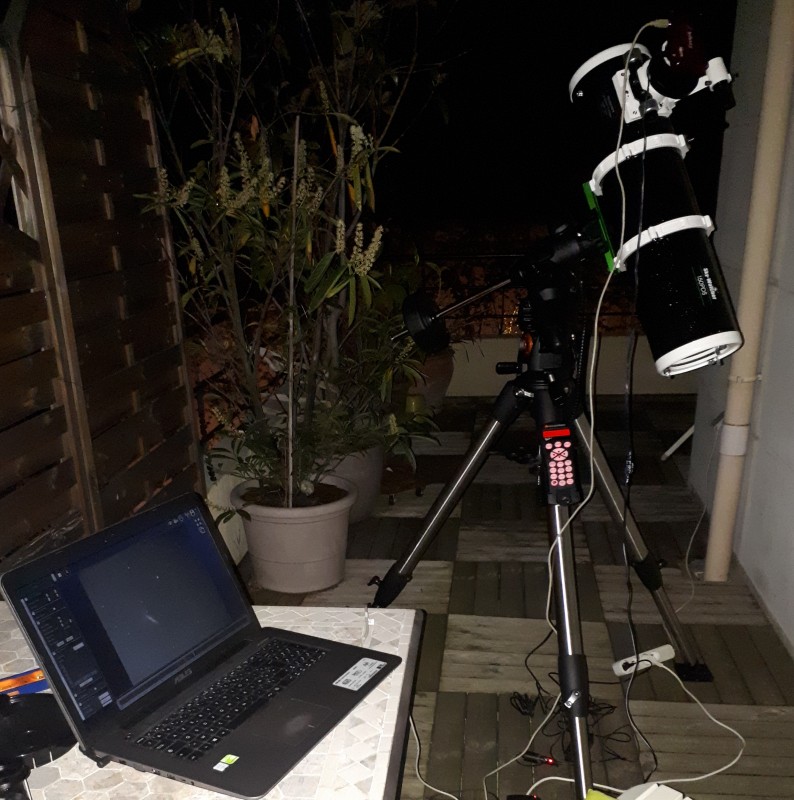
After a year of testing on a small hardware configuration, here is the camera installed at the focus of a Newton telescope with a diameter of 150 mm (suitable for weakly luminous objects) and driven on a Celestron AVX equatorial mount (this mount is able to support 13 KG of instrumental load)


2) Ideas for an observing project :


In 2001, I bought an original refracting telescope, which appealed to me with its compact shape so I could take it when traveling. I used it to take photographs of solar eclipses. It is an achromatic refractor 80mm in diameter, with 480mm focal length, the "shuttle Scope 80" from Perl, which is light and which has a tube which deploys, allowing 3 different configurations: as an astronomical telescope, as a long- view and telephoto. It can be attached to a simple photo mount. It looks a bit like a thermos flask !


I actively practiced astronomy in a Club, I led practical training for beginner members. In 2010, my passion for the stars suddenly declined. In 2016, I became interested in the stars again following a vacation spent in Provence where the starry sky was captivating.
In a new apartment acquired in Lyon, a terrace is well located to act as a "temporary or ephemeral observatory":
- It is located high up just above the street lamps: there is no direct lighting.
- It is oriented away from the city center: there is less light pollution.
- It is open to the sky under at least a fifth of the celestial vault: we see the zenith
- The polar star is visible there: this is necessary to align the equatorial mount

I first gauged the relative quality of the sky with the telescope in visual. I can observe the brightest nebulae.
Could the deep sky be more accessible with the help of a digital camera?
I always heard that it was unthinkable to observe the deep sky in the city (distant and faintly luminous astronomical objects) and that at best, only the Moon and the planets could be observed!
Having no clear view towards the South and therefore the ecliptic (plane of the Earth's trajectory rotating around the Sun; therefore with some differences in inclination, all the planets are moving near this line, which crosses, among other things, the famous constellations of the Zodiac); there was no point in investing in a specialized planetary instrument.

Useful details:


An optical instrument is characterized by:

THE APERTURE (D) is the diameter of the lens for a telescope or of the main mirror for a telescope. The larger the diameter, the more light the instrument will collect (hence an increase in the gigantism of professional telescopes which from 8 to 10 meters will soon reach 30 meters in diameter!) It is this characteristic which defines the power of the instrument.

The FOCAL (F): it is determined by the shape of the lens or mirror which will also size the instrument (for the same optical diameter, the instrument will be longer if the focal length is greater); if the focal length is larger: you obtain more visual magnifying power or a smaller field for imaging. For example, if you want to photograph a vast landscape or the moon among a constellation, you need a low focal length and if you want to photograph an animal up close seen in the landscape or get a close-up of a lunar crater, you need an important focal length.

The RATIO (F/D): The FOCAL/APERTURE ratio is a summary defining the luminosity of the instrument: The lower the F/D ratio, the brighter the visual observation can be, the longer the exposure time in photograph may be short.
The greater the F/D ratio, the weaker the observation can be, and the longer the exposure time must be.

To observe/photograph planets (which are quite bright), you need a larger focal length and the F/D may be important. The main enemy will be atmospheric turbulence which will disturb and deform the enlarged object.

To observe/photograph deep sky objects like galaxies (which are faint), a larger diameter is required and the F/D must be limited. The main enemy will be the brightness of the sky (light pollution or the presence of the full Moon).


Field with 420mm focal length


Field with 750mm focal length


Field with 1500mm focal length


The F/D ratio of my telescope is equal to 6 and access to the deep sky is therefore possible.

I embarked on a study to purchase a high-performance CCD camera for a price that did not exceed $1000 and my choice fell on an Atik Infinity with a black and white sensor.
Its advantages :
- A significant quantum yield of the CCD sensor (around 60% of photons on average are converted into electrons which will form digital information) (the quantum yield of silver films which made it possible to produce a photograph, in the last century was 5% approximately! the progress is substantial and it has ended up satisfying amateur astronomers).
- Dedicated software makes it possible to automatically and continuously add the acquisitions of the CCD sensor following a short exposure time. The display of the imaged object appears better and better on the screen, some speak of an assisted visual technique, I prefer to speak of an observation with a CCD camera.

Its disadvantages :
- A sensor of modest size
- No cooling device to allow long exposures (which limits the exposure to two minutes otherwise the image is very noisy): it is less useful under a polluted sky.
- No software that allows you to automatically and completely process the image with offset, black and PLU: you can always dream!

In conclusion, it is a high-performance camera which is not dedicated to astrophotography.


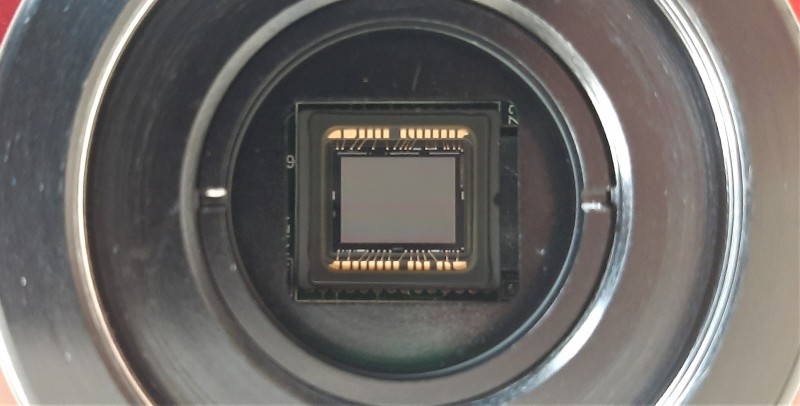
View of the Sony ICX825 NB CCD sensor from the Atik Infinity camera


The characteristics of the Sony ICX825 CCD sensor are a matrix of 1392 x 1040 photosites (pixel) of 6.45 µm x 6.45 µm which gives a sensor dimension of 8.98 mm x 6.71 mm.
The dimension of the CCD matrix in mm is very useful for calculating the expected field with such optical configuration focal length.

The formula is A= (3438 xd) / F
A is the field in arc minutes that we want to know (the diameter of the Moon corresponds to approximately 30 arc minutes)
d is the dimension in length or in width of the sensor in mm and F is the optical focal length of the instrument always in mm.

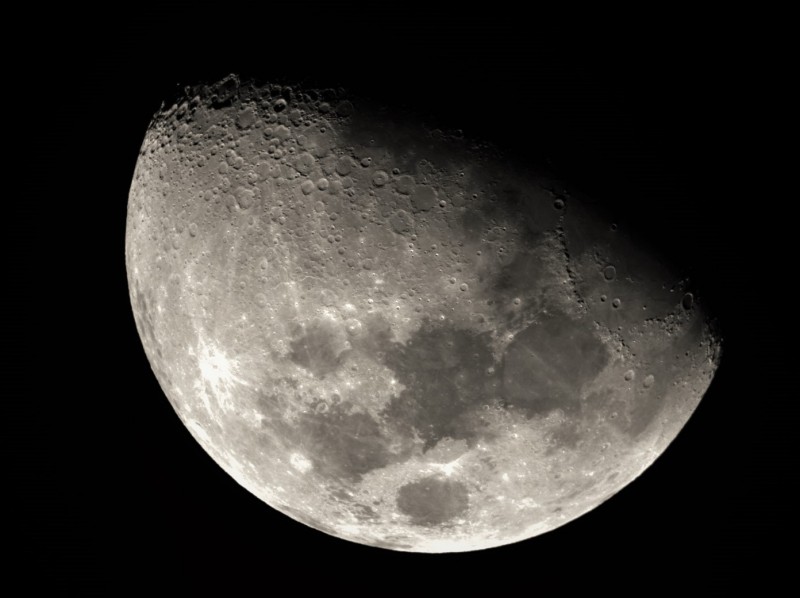
For example: With the T150/750 the expected field with the CCD sensor of the atik infinity is 41' by 31' (The Moon can just enter the field)
With a 72/420 refractor the expected field is 73' by 55'

I mounted this camera at the focus of the telescope, driven by a small motorized equatorial mount in right ascension, a Mini Eq. The axis of the mount is roughly oriented towards the polar star of the constellation Ursa Minor. Images remain sharp (without star trails) for up to 12 seconds. The software succeeds perfectly in adding several dozen images in a row and the "live" result is correct.


| The Universe | Practise - Observing | Our Galaxy - The Milky Way | Galaxies | Quasars - Expansion of the Universe |

Observing the Universe - Practise - Observing (Sciences - Astronomy)    -    Author : Frédéric - France


1557 visitors since 2024-03-24
Last update : 2024-04-28

Blog-City.info >> Sciences >> Blog #33795

Create your own
WEBSITE !
PICTURES OF FRANCE


Visit France !

website author area
Password :
Forgot password? - unpublish